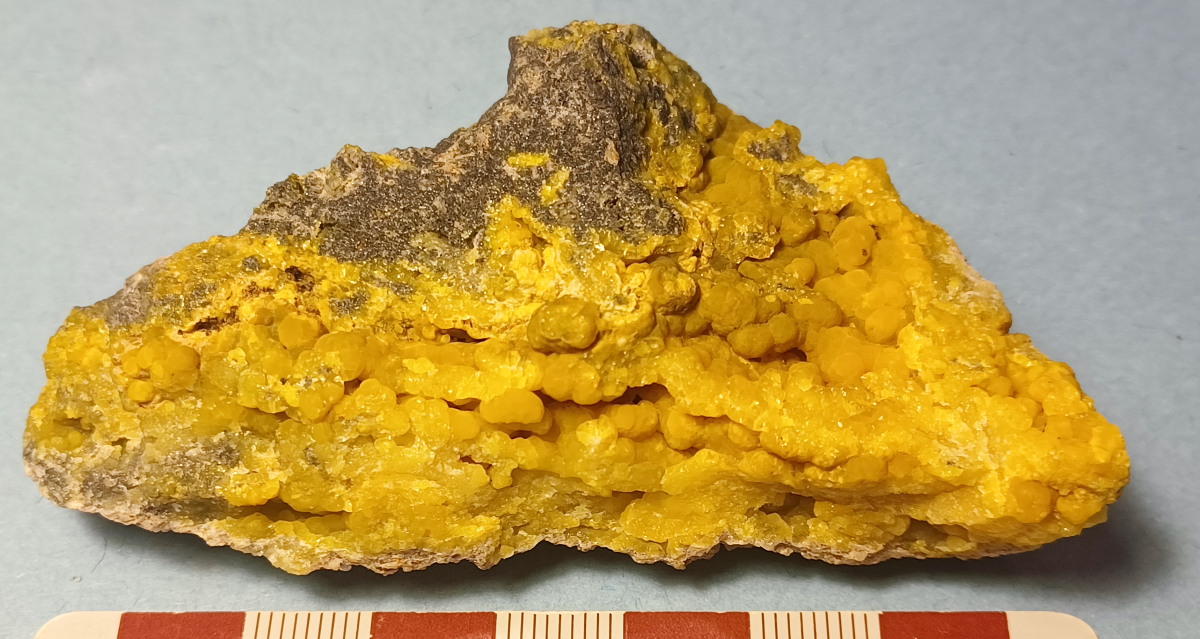
"Rock of the Month # 298, posted for April 2025" ---
Smithsonite
trigonal (rhombohedral) zinc carbonate, ZnCO3
See a more detailed account of the occurrence of smithsonite
here, with an
example of pink crystals from Tsumeb, Namibia.
Here are a few updates to that Rock of the Month,
from September 2017:
Smithsonite is known elsewhere in Ireland, e.g., as a secondary mineral at the Silvermines Pb- Zn- Ba deposit in county Tipperary (Boland et al., 1992).
Smithsonite occurs with other secondary minerals on zinc occurrences in southeast British Columbia, Canada (e.g., Paradis et al., 2016).
At the Pinargozu Zn mine in Turkey, deeper ore is sulphide-dominant, and may grade as high as 55% Zn. Above is secondary mineralization, generating smithsonite feed.
Drill core and some drifts along the mine workings
are spectacular with botryoidal and vuggy smithsonite (Williams, 2017).
Fine specimens of diverse colours are known from around the world, as at Santa Eulalia in
northwest Mexico (Megaw, 2018). Pseudomorphs of yellow smithsonite after dolomite are reported from Marion county, Arkansas, USA (Young and Wilson, 2025).
Smithsonite may also replace tarnowitzite (a lead-bearing form of the CaCO3 polymorph aragonite), as at Tsumeb (Young, 2025).
The Burren, county Clare
The Burren is a unique geological region in western county Clare, recognized as a UNESCO world heritage site. The region is underlain by Carboniferous limestones and other sedimentary rocks (Holland, 2001), and karst landforms are developed by the progressive weathering of the water-soluble strata (Steers, 1969; Hennessy et al., 2017). The geology of the bedrock and the landscape features, and the overlying wild flowers and farming are all aspects of a fascinating region of Ireland (Praeger, 1937; Kirby, 2014).
REFERENCES
Boland,MB, Clifford,JA, Meldrum,AH and Poustie,A (1992) Residual base metal and barite mineralization at Silvermines, Co. Tipperary, Ireland. In `The Irish Minerals Industry, 1980-1990' (Bowden,AA, Earls,G, O'Connor,PG and Pyne,JF editors), Irish Association for Economic Geology, Dublin, 436pp., 247-260.
Hennessy,R, McNamara,M and Hoctor,Z (2017) Stone, Water and Ice: a Geology Trip through the Burren. Geological Survey of Ireland, 3rd edition, 132pp.
Holland,CH (editor) (2001) The Geology of Ireland. Dunedin Academic Press, Edinburgh, 531pp.
Kirby,T (2014) The Burren & the Aran Islands, a walking guide. Collins Press, 122pp.
Megaw,PKM (2018) The Santa Eulalia mining district, Chihuahua, Mexico. Mineral.Record 49 no.1, 4-184.
Paradis,S, Simandl,GJ, Keevil,H and Raudsepp,M (2016) Carbonate-hosted nonsulfide Pb-Zn deposits of the Quesnel Lake district, British Columbia, Canada. Econ.Geol. 111, 179-198.
Praeger,RL (1937) The Way that I Went. Collins Press Ireland, 2nd edition, xii+394pp., republished 2014.
Steers,JA (1969) Coasts and Beaches. Oliver & Boyd, Edinburgh, 136pp.
Williams,S (2017) High grade zinc: production, exploration and opportunity. Presentation 25 to Kawartha Geoscience Network (Kawartha and Region Earth Sciences, Engineering and Metallurgy Network, KREEM), Peterborough, ON, 05 December.
Young,S (2025) Pseudomorphs: a collector's journey. Mineralogical Record 56 no.1, supplement, 112pp., 61-70.
Young,S and Wilson,WE (2025) Pseudomorphs and the Young Mineral Collectors. Mineralogical Record 56 no.1, supplement, 112pp., 55-60.